Hard disks are rigid platters, composed of a substrate and a magnetic medium. The substrate – the platter’s base material – must be non-magnetic and capable of being machined to a smooth finish. It is made either of aluminum alloy or a mixture of glass and ceramic. To allow data storage, both sides of each platter are coated with a magnetic medium – formerly magnetic oxide, but now, almost exclusively, a layer of metal called a thin-film medium. This stores data in magnetic patterns, with each platter capable of storing a billion or so bits per square inch (bpsi) of platter surface.
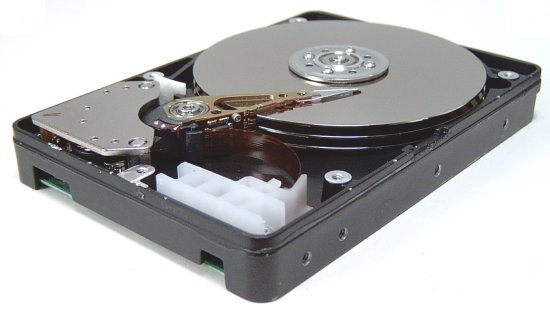
Platters vary in size and hard disk drives come in two form factors, 5.25in or 3.5in. The trend is towards glass technology since this has the better heat resistance properties and allows platters to be made thinner than aluminium ones. The inside of a hard disk drive must be kept as dust-free as the factory where it was built. To eliminate internal contamination, air pressure is equalised via special filters and the platters are hermetically sealed in a case with the interior kept in a partial vacuum. This sealed chamber is often referred to as the head disk assembly (HDA).
Geometry
Typically two, three or more platters are stacked on top of each other with a common spindle that turns the whole assembly at several thousand revolutions per minute. There’s a gap between the platters, making room for magnetic read/write head, mounted on the end of an actuator arm. This is so close to the platters that it’s only the rush of air pulled round by the rotation of the platters that keeps the head away from the surface of the disk – it flies a fraction of a millimetre above the disk. On early hard disk drives this distance was around 0.2mm. In modern-day drives this has been reduced to 0.07mm or less. A small particle of dirt could cause a head to crash, touching the disk and scraping off the magnetic coating. On IDE and SCSI drives the disk controller is part of the drive itself.
There’s a read/write head for each side of each platter, mounted on arms which can move them towards the central spindle or towards the edge. The arms are moved by the head actuator, which contains a voice-coil – an electromagnetic coil that can move a magnet very rapidly. Loudspeaker cones are vibrated using a similar mechanism.
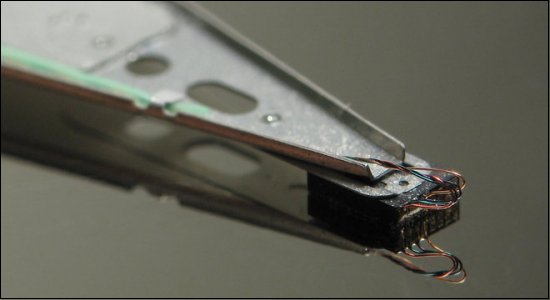
The heads are designed to touch the platters when the disk stops spinning – that is, when the drive is powered off. During the spin-down period, the airflow diminishes until it stops completely, when the head lands gently on the platter surface – to a dedicated spot called the landing zone (LZ). The LZ is dedicated to providing a parking spot for the read/write heads, and never contains data.
Data Storage | Flash Memory Card
- Hard disk (hard drive) construction
- Hard Disk (hard drive) Operation
- Hard disk (hard drive) format – the tracks and sectors of the hard disk
- File systems (FAT, FAT8, FAT16, FAT32 and NTFS) explained
- Hard Disk (Hard Drive) Performance – transfer rates, latency and seek times
- Hard Disk AV Capability
- Hard Disk Capacity
- Hard Disk Capacity Barriers
- Hard Disk MR Technology
- Hard Disk GMR Technology
- Hard Disk Pixie Dust
- Hard Disk Longitudinal Recording
- Hard Disk Perpendicular Recording
- RAID – Redundant Arrays of Inexpensive Disks
- Hard Disk SMART Drives
- Hard Disk MicroDrives
- Hard Disk OAW Technology
- Hard Disk PLEDM
- Hard Disk Millipede
- Guide to Western Digital’s GreenPower hard drive technology
- Solid state hard drive (SSD) technology guide
Very interesting article! Thanks 🙂
“In modern-day drives this has been reduced to 0.07mm or less”
This figure is 20000 times greater than actual. 3nm is modern head-disk clearance.
Old 20 MB ST225 had recording density about 500 flux transition/mm, which already required clearance less than 1 micron.
No. Its 300,000 smaller then stated…Its 1nm clearance…