pctechguide.com

  • Home
  • Guides
  • Tutorials
  • Articles
  • Reviews
  • Glossary
  • Contact

Motherboard Memory Installation

Different types of memory need to be installed in different ways, so it’s safest to refer to both your motherboard User’s Manual and the documentation that came with the memory itself when doing this.

In this case the memory is SDRAM packaged in a DIMM memory module.
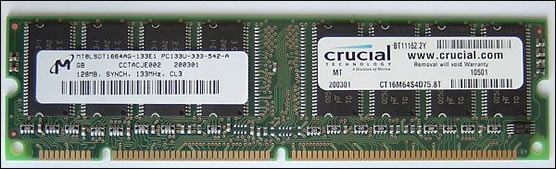
DIMM

With many motherboards, DIMM memory can be installed in any available expansion slot. If that’s the case, whilst others may require the memory to be installed in a particular sequence, based on the module’s capacity. Unless your motherboard’s User’s Manual says otherwise, it’s generally best to fill your DIMM slots starting with the largest density in the first bank (labelled as either DIMM0 or DIMM1), the next largest in the next bank, and so on.

DIMM modules and slots have notches to prevent you from installing the memory the wrong way round. However, the notches are different for 3.3V, 5V, buffered and unbuffered modules – which is why it’s so important to correctly identify which type of memory your particular motherboard requires in the first place!

Line up the notches in the DIMM module with the notches in the DIMM slot and press the module firmly into the slot until the latches on either end lock down. This can require quite a bit of force, so be persistent and make sure the force is applied evenly along the length of the module and with it at 90 degrees to the DIMM slot.

Anyone doing a motherboard upgrade today is likely to be using a board that supports one of two types of memory form factor:

  • 168-pin DIMMs, or
  • 184-pin RIMMs

The procedure for installing 168-pin DIMM modules has already been covered above. However, it’s worth noting that whilst most motherboards using DDR memory allow you to install memory a single module at a time, a few are now capable of benefiting from dual-channel DDR memory.

The installation of 184-pin RIMMs is much the same as for DIMMs. As for the latter, RIMM modules can generally be installed in any available expansion socket. However, with 16-bit RDRAM modules any empty socket must contain a C-RIMM (Continuity RIMM).


  • Motherboard Upgrade Reasons
  • Motherboard Removal
  • Motherboard CPU
  • Motherboard Heatsinks
  • Motherboard Memory Identification
  • Motherboard Memory Installation
  • Motherboard Fit
  • Motherboard Power
  • Motherboard Panel
  • Motherboard Fan
  • Motherboard USB Ports
  • Motherboard FireWire Ports
  • Motherboard Audio
  • Motherboard Testing
  • Motherboard Floppy Connections
  • Motherboard IDE Connections
  • BIOS Settings
  • Motherboards and Win98
  • Motherboards and WinXP

Filed Under: How to Upgrade Your Motherboard

Latest Articles

ADR Tape Technology

Advanced Digital Recording technology is the product of seven years of research on the part of electronics industry giant Philips. To provide the focus needed to successfully bring ADR to market, Philips created a spin-off company - … [Read More...]

Navegaki.com.br Removal

Navagaki.com.br is a browser hijacker. The .br in the domain name is for domain names that are registered in Brazil. However, that does not mean it will not appear if you are in another country. Navegaki.com.br will change the settings in your browser and will force it to open the page each time … [Read More...]

LCD Light Polarisation

LCD is described as a transmissive technology because the display works by letting varying amounts of a fixed-intensity white backlight through an active filter. The red, green and blue elements of a pixel are achieved through simple filtering of the white light. Most liquid crystals … [Read More...]

Everything You Need to Know About Sourcing Circuit Boards From U.S. Suppliers

In This Article This article includes: Why Source PCBs From the United States?How to Get a Quote From a U.S.-Based PCB ManufacturerThe Top U.S. … [Read More...]

Top Taplio Alternatives in 2025 : Why MagicPost Leads for LinkedIn Posting ?

LinkedIn has become a strong platform for professionals, creators, and businesses to establish authority, grow networks, and elicit engagement. Simple … [Read More...]

Shocking Cybercrime Statistics for 2025

People all over the world are becoming more concerned about cybercrime than ever. We have recently collected some statistics on this topic and … [Read More...]

Gaming Laptop Security Guide: Protecting Your High-End Hardware Investment in 2025

Since Jacob took over PC Tech Guide, we’ve looked at how tech intersects with personal well-being and digital safety. Gaming laptops are now … [Read More...]

20 Cool Creative Commons Photographs About the Future of AI

AI technology is starting to have a huge impact on our lives. The market value for AI is estimated to have been worth $279.22 billion in 2024 and it … [Read More...]

13 Impressive Stats on the Future of AI

AI technology is starting to become much more important in our everyday lives. Many businesses are using it as well. While he has created a lot of … [Read More...]

Guides

  • Computer Communications
  • Mobile Computing
  • PC Components
  • PC Data Storage
  • PC Input-Output
  • PC Multimedia
  • Processors (CPUs)

Recent Posts

Digital Video Editing

Broadly speaking, there are two types of video editing. One involves editing directly from one tape to another and is called linear editing. The other … [Read More...]

Spear Phishing – The New Cyber Attack

Hackers come up with new ways every day to gain access to our computers. They have been evolving on a continual basis, and there is a new attack that … [Read More...]

ADSL2+ | ADSL2Plus | ITU G.992.5

ADSL2+ reached consent at the ITU in January 2003, joining the ADSL2 standards family as G.992.5. The ADSL2+ recommendation doubles the downstream … [Read More...]

[footer_backtotop]

Copyright © 2026 About | Privacy | Contact Information | Wrtie For Us | Disclaimer | Copyright License | Authors