pctechguide.com

  • Home
  • Guides
  • Tutorials
  • Articles
  • Reviews
  • Glossary
  • Contact

Opto-Mechanical mice

The mouse was invented by Douglas Engelbart of Stanford Research Institute in 1963. The first devices were bulky and used two gear wheels perpendicular to each other: the rotation of each wheel was translated into motion along one axis in the plane. By the early 1970s the external wheels had been replaced by a single internal ball that could rotate in any direction and whose motion was detected using perpendicular wheels housed inside the mouse’s body. This variant of the mouse resembled an inverted trackball.

The first PCs were equipped with the traditional user input device – a keyboard. Microsoft’s first PC-specific mouse, designed for use with the company’s word processing application, appeared in 1982. By the end of the 1980s, the inverted trackball style of mouse had become an essential for PCs running the GUI-based Windows operating system. It remained the predominant form of mouse used with personal computers through the 1990s.

The ball of an opto-electronic mouse is steel for weight and rubber-coated for grip. When the mouse is moved, the ball rotates, and as it does so it drives two rollers, one each for x and y displacement. A third spring-loaded roller holds the ball in place against the other two. These rollers then turn two disks with radial slots cut in them. Each disk rotates between a photo-detector cell, and each cell contains two offset light emitting diodes (LEDs) and light sensors. As the disk turns, the sensors see the light appear to flash, showing movement, while the offset between the two light sensors shows the direction of movement.
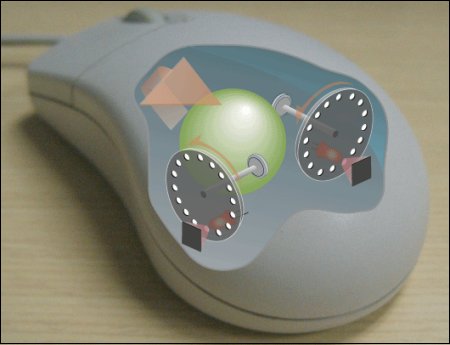
Mouse

Also inside the mouse are a switch for each button, and a microcontroller which interpret the signals from the sensors and the switches, using its firmware program to convert them to X and Y velocities and translate them into packets of data which are sent to the PC. Serial mice use voltages of 12V and an asynchronous protocol from Microsoft comprised of three bytes per packet to report x and y movement plus button presses. PS/2 mice use 5V and an IBM-developed communications protocol and interface.

  • Keyboards
  • Ergonomic Keyboards
  • Opto-Mechanical mice
  • Optical Mice
  • Cordless Input Devices
  • Laser Mice
  • Trackballs
  • Joysticks
  • Input Device Interfaces
  • Touchscreens

Filed Under: Input Devices

Latest Articles

Android Marshmallow is Here

The rumor mill has been churning for some time now about the release of the latest and greatest Andoid operating system. Well, its time has finally arrived, and it will be known as Marshmallow.  It follows in the footsteps of previous foodstuff-inspired Android operating system releases, including … [Read More...]

Protect Your Business with Online Reputation Management

As a company grows the potential for negative comments online become more common. This type of activity needs to be monitored for potential issues.  Online Reputation Management (ORM) is important, and here’s how you can get started with it. ORM is still a relatively new concept, and one that small … [Read More...]

The Different Types of CRT Monitors – From ShortNeck to FST

By the beginning of 1998 15in monitors were gradually slipping to bargain-basement status, and the 17in size, an excellent choice for working at 1024x768 (XGA) resolution, was moving into the slot reserved for mainstream desktops. At the … [Read More...]

Comments

  1. shyam says

    February 5, 2014 at 7:43 am

    how can it move in opposite direction

Shocking Cybercrime Statistics for 2025

People all over the world are becoming more concerned about cybercrime than ever. We have recently collected some statistics on this topic and … [Read More...]

Gaming Laptop Security Guide: Protecting Your High-End Hardware Investment in 2025

Since Jacob took over PC Tech Guide, we’ve looked at how tech intersects with personal well-being and digital safety. Gaming laptops are now … [Read More...]

20 Cool Creative Commons Photographs About the Future of AI

AI technology is starting to have a huge impact on our lives. The market value for AI is estimated to have been worth $279.22 billion in 2024 and it … [Read More...]

13 Impressive Stats on the Future of AI

AI technology is starting to become much more important in our everyday lives. Many businesses are using it as well. While he has created a lot of … [Read More...]

Graphic Designers on Reddit Share their Views of AI

There are clearly a lot of positive things about AI. However, it is not a good thing for everyone. One of the things that many people are worried … [Read More...]

Redditors Talk About the Impact of AI on Freelance Writers

AI technology has had a huge impact on our lives. A 2023 survey by Pew Research found that 56% of people use AI at least once a day or once a week. … [Read More...]

Guides

  • Computer Communications
  • Mobile Computing
  • PC Components
  • PC Data Storage
  • PC Input-Output
  • PC Multimedia
  • Processors (CPUs)

Recent Posts

20 Spectacular Images About Artificial Intelligence

In the age of artificial intelligence, the very fabric of our world is undergoing a profound transformation. From enhancing everyday tasks to … [Read More...]

11 Invaluable Tips to Make the Most of Your Flash Drive

Many people are surprised to hear that flash drives are still very popular. However, the market for them is growing by 7% a year. It is a good idea … [Read More...]

Waterfall Software Life Cycle Model

he following diagram draws from the sphere of engineering, showing the traditional (also known as classic) and most straightforward approach to … [Read More...]

[footer_backtotop]

Copyright © 2025 About | Privacy | Contact Information | Wrtie For Us | Disclaimer | Copyright License | Authors