Many first-generation digital cameras contained one or two megabytes of internal memory suitable for storing around 30 standard-quality images at a size of 640×480 pixels. Unfortunately, once the memory had been filled no more pictures could be taken until they’d been transferred to a PC and deleted from the camera.
Modern digital cameras use removable storage. This offer two main advantages: first, once a memory card is full it can simply be removed and replaced by another; second, given the necessary PC hardware, memory cards can be inserted directly into a PC and the photos read as if from a hard disk. By early 1999 two rival formats were battling for domination of the digital camera arena:
- CompactFlash: First introduced in 1994 by SanDisk corporation, and based on flash memory technology, CompactFlash (CF) provides non-volatile storage that doesn’t require a battery to retain data. It’s essentially a PC Card flash card that’s been reduced to about one quarter of its original size and uses a 50-pin connection that fits into a standard 68-pin Type II PC Card adapter. This makes it easily compatible with devices designed to use PC Card flash RAM. CompactFlash cards measure 43mm by 36mm. They are available in both Type I and Type II cards, although predominately the former. A Type I card is 3.3mm thick and will operate in both a Type I and a Type II slot. A Type II card 5mm and will operate in a Type II slot only. By late 2001 maximum capacities had reached 512MB.
- SmartMedia: Originally known by the awkward acronym SSFDC (Solid-State Floppy Disk Card) when it first appeared in 1996, the Toshiba-developed SmartMedia cards are significantly smaller and lighter than CompactFlash cards, weighing 0.48g with a form factor of 45 by 37mm and a thickness of only 0.78mm. It uses its own proprietary 22-pin connection – but like its rival format is PCMCIA-ATA-compatible and can therefore be adapted for use in notebook PC Card slots. Capacities are less than for CompactFlash – 128MB was still the maximum capacity by late 2001, capable of storing 560 high-resolution (1200×1024) still photographs – and cost per megabyte is similar to that of CompactFlash.
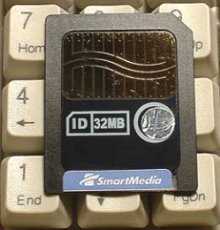
Devices are available for both types of media to allow access via either a standard floppy disk drive or a PC’s parallel port. The highest performance option is a SCSI device which allows PC Card slots to be added to a desktop PC. CompactFlash has a far sturdier construction than its rival, encapsulating the memory circuitry in a hard-wearing case. SmartMedia has its gold-coloured contact exposed, and prolonged use can cause scoring on its surface. Its memory circuitry is set into resin and sandwiched between the card and the contact. CompactFlash can operate between temperatures of 25°C to 75°C and claims a 100-year usage life; SmartMedia can be used between 0°C to 50°C and claims that it can be written to at least 250,000 times.
With the 24-bit colour, 1800×1200 resolution images being produced by consumer models by mid-1999 occupying a massive 6.2MB – storage capacity is becoming an increasingly important aspect of digital camera technology. It is not clear which format will emerge as winner in the standards battle. SmartMedia has got off to a good start, but CompactFlash is used in PDAs as well, and this extra versatility might prove an important advantage in the long run.
By the end of 1999 a third memory technology had emerged, in the shape of Sony’s Memory Stick. Smaller than a stick of chewing gum and initially available with a capacity of 32MB, Memory Stick is designed for use in small AV electronics products such as digital cameras and camcorders. Its proprietary 10-pin connector ensures foolproof insertion, easy removal, and reliable connection and its unique Erasure Prevention Switch helps protect stored data from accidental erasure. Capacities had risen to 128MB by late 2001, with the technology roadmap for the product going all the way up to 1GB.
By the end of 2001 the digital camera memory market share for CompactFlash, SmartMedia and Memory Stick was estimated to be around 44%, 33% and 6% respectively.
- What is CCD in the Context of Digital Cameras?
- CMOS Digital Cameras
- What Controls The Picture Quality of a Digital Camera
- Features and Parts of a Digital Camera
- PIM Technology
- Digital Camera Batteries: Types and How They Work
- Memory Storage
- Storage of Photos and Videos on Digital Cameras
- Digital Camera Connectivity
- Digital Cameras vs. Film
- X3 Technology
- What is PictBridge and PTP?