In the late 1990s, the PC industry developed a need for a riser architecture that would contribute towards reduced overall system costs and at the same time increase the flexibility of the system manufacturing process. The Audio/Modem Riser AMR) specification, introduced in the summer of 1998, was the beginning of a new riser architecture approach. AMR had the capability to support both audio and modem functions. However, it did have some shortcomings, which were identified after the release of the specification. These shortcomings included the lack of Plug and Play (PnP) support, as well as the consumption of a PCI connector location.
Consequently, new riser architecture specifications were defined which combine more functions onto a single card. These new riser architectures combine audio, modem, broadband technologies, and LAN interfaces onto a single card. They continue to give motherboard OEMs the flexibility to create a generic motherboard for a variety of customers. The riser card allows OEMs and system integrators to provide a customised solution for each customer’s needs. Two of the most recent riser architecture specifications include CNR and ACR.
CNR – Communications and Networking Riser
Intel’s CNR (Communication and Networking Riser) specification defines a hardware scalable OEM motherboard riser and interface that supports the audio, modem, and LAN interfaces of core logic chipsets. The main objective of this specification is to reduce the baseline implementation cost of features that are widely used in the Connected PC, while also addressing specific functional limitations of today’s audio, modem, and LAN subsystems.
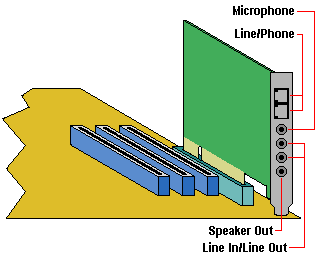
PC users’ demand for feature-rich PCs, combined with the industry’s current trend towards lower cost, mandates higher levels of integration at all levels of the PC platform. Motherboard integration of communication technologies has been problematic to date, for a variety of reasons, including FCC and international telecom certification processes, motherboard space, and other manufacturer specific requirements.
Motherboard integration of the audio, modem, and LAN subsystems is also problematic, due to the potential for increased noise, which in-turn degrades the performance of each system. The CNR specifically addresses these problems by physically separating these noise-sensitive systems from the noisy environment of the motherboard.
With a standard riser solution, as defined in this specification, the system manufacturer is free to implement the audio, modem, and/or LAN subsystems at a lower bill of materials (BOM) cost than would be possible by deploying the same functions in industry-standard expansion slots or in a proprietary method. With the added flexibility that hardware scalability brings, a system manufacturer has several motherboard acceleration options available, all stemming from the baseline CNR interface.
The CNR Specification supports the five interfaces:
- AC97 Interface – Supports audio and modem functions on the CNR card
- LAN Connect Interface (LCI) – Provides 10/100 LAN or Home Phoneline Networking capabilities for Intel chipset based solutions
- Media Independent Interface (MII) – Provides 10/100 LAN or Home Phoneline Networking capabilities for CNR platforms using the MII Interface
- Universal Serial Bus (USB) – Supports new or emerging technologies such as xDSL or wireless
- System Management Bus (SMBus) – Provides Plug and Play (PnP) functionality on the CNR card.
Each CNR card can utilise a maximum of four interfaces by choosing the specific LAN interface to support.
ACR – Advanced Communications Riser
The rival ACR (Advanced Communications Riser)specification is supported by an alliance of leading computing and communication companies, whose founders include 3COM, AMD, VIA Technologies and Lucent Technologies. Like CNR, it defines a form factor and interfaces for multiple and varied communications and audio subsystem designs in desktop OEM personal computers. Building on first generation PC motherboard riser architecture, ACR expands the riser card definition beyond the limitation of audio and modem codecs, while maintaining backward compatibility with legacy riser designs through an industry standard connector scheme. The ACR interface combines several existing communications buses, and introduces new and advanced communications buses answering industry demand for low-cost, high-performance communications peripherals.
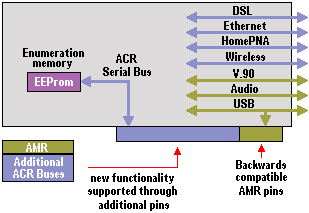
ACR supports modem, audio, LAN, and xDSL. Pins are reserved for future wireless bus support. Beyond the limitations of first generation riser specifications, the ACR specification enables riser-based broadband communications, networking peripheral and audio subsystem designs. ACR accomplishes this in an open-standards context.
Like the original AMR Specification, the ACR Specification was designed to occupy or replace an existing PCI connector slot. This effectively reduces the number of available PCI slots by one, regardless of whether the ACR connector is used. Though this may be acceptable in a larger form factor motherboard, such as ATX, the loss of a PCI connector in a microATX or FlexATX motherboard – which often provide as few as two expansion slots – may well be viewed as an unacceptable trade-off. The CNR specification overcomes this issue by implementing a shared slot strategy, much like the shared ISA /PCI slots of the recent past. In a shared slot strategy, both the CNR and PCI connectors effectively use the same I/O bracket space. Unlike the ACR architecture, when the system integrator chooses not to use a CNR card, the shared PCI slot is still available.
Although the two specifications both offer similar functionality, the way in which they are implemented are quite dissimilar. In addition to the PCI connector/shared slot issue, the principal differences are as follows:
- ACR is backwards compatible with AMR, CNR isn’t
- ACR provides support xDSL technologies via its Integrated Packet Bus (IPB) technology; CNR provides such support via the well-established USB interface
- ACR provides for concurrent support for LCI (LAN Connect Interface) and MII (Media Independent Interface) LAN interfaces; CNR supports either, but not both at the same time
- The ACR Specification has already reserved pins for a future wireless interface; the CNR specification has the pins available but will only define them when the wireless market has become more mature.
Ultimately, motherboard manufacturers are going to have to decide whether the ACR specification’s additional features are worth the extra cost.
- Evolution of the motherboard
- BIOS – What motherboard BIOS does for a PC
- CMOS – complementary metal oxide silicon – RAM chips on motherboards
- EFI – Extensible Firmware Interface – explained
- Motherboard form factors
- Baby AT (BAT) Motherboard Form Factor
- LPX – Low Profile eXtension motherboard form factor
- ATX form factor
- NLX – New Low profile eXtended – form factor for motherboards
- Micro ATX motherboard form factor
- FlexATX motherboard form factor
- BTX – Balanced Technology eXtended – Motherboard Form Factor
- Riser architectures for motherboards
- CPU interfaces – motherboard slots and sockets for AMD and Intel processors