ADSL has several similarities to ISDN. Both technologies require that copper phone lines be electrically clean and both can operate only a limited distance away from the phone company’s local exchange. In most cases, ADSL can operate over existing voice-grade, twisted-pair phone cables without disturbing the existing telephone connections – meaning that local phone companies don’t have to run additional lines to provide ADSL service.
ADSL works on the principle that since voice does not use anything like all of the bandwidth available from a standard copper twisted pair line, it’s possible to maintain a high-speed data connection at the same time. To do this, ADSL splits the 1MHz maximum bandwidth of a copper wire connection into 4KHz channels only the bottom 4KHz channel for plain old telephone system (POTS) conversations, fax and analogue modem data. The other 256 available channels are used for parallel digital communication. Being asymmetric, 192 4KHz channels are used for the downlink and only 64 for the uplink.
In this way ADSL can be viewed as simply taking a serial string of digital data and converting it into a parallel string, thereby increasing data throughput. The modulation technique is known as Discrete Multitone (DMT), the encoding and decoding is performed at the exchange and at the user end respectively, in the same way as it is by a conventional dial-up modem.
An earlier system, called Carrierless Amplitude Phase (CAP), was able to use all the bandwidth above 4KHz as a single transmission channel, had the advantage of being closely related to the Quadrature Amplitude Modulation (QAM) technique used by high-speed modems at rates above 9.6 Kbit/s and was also cheaper to implement. However, DMT is a more reliable, sophisticated and flexible technology, and has succeeded in becoming the universally adopted standard.
When the service first became commercially available, the only additional equipment subscribers needed to use ADSL was a suitable modem. While these devices were still being developed, prototypes had three connectors on the back of the unit: one going to the wall jack and then out to the phone company; one was a standard RJ11 phone jack for analogue phone service; and one was an Ethernet twisted-pair connector that connected the ADSL modem to a PC.
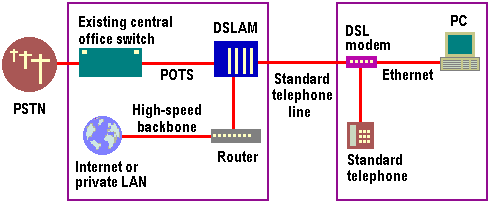
At the user end, the ADSL modem collects high-frequency digital data and assembles it for transmission to the PC or network. At the exchange end, a Digital Subscriber Line Access Multiplexer (DSLAM) connects the ADSL user to the wider Internet, aggregating incoming ADSL lines into a single data connection for transmission onto voice and data networks. The phone signals are sent to the switched telephone network and the digital data routed data to the Internet via a high-speed backbone (implemented as T1, fibre, ATM, or DSL).
ADSL modems have evolved over the years and are now available in a number of forms. Some connect to a PC via a USB port, others via Ethernet. Most devices allow an Internet connection to be shared across several PCs. Integrated modem/routers support a network of PCs, some coming with an integrated firewall to provide varying levels of protection against unauthorised access.
192 4KHz uplink channels provide for a maximum bandwidth of 8 Mbit/s. The reason commercial ADSL services are limited to a maximum of only 2 Mbit/s is explained by a combination of the fact that bandwidth is being artificially throttled and that actual performance levels depend on a number of external factors. These include the length of the copper line, its wire gauge, the presence of bridged taps and cross-coupled interference. Line attenuation increases with line length and frequency, and decreases as wire diameter increases. A bridged tap is an unterminated wire pair that sits in parallel to the main wire pair. In the local loop they appear when the local phone company taps off an existing pair to provision a new service to a new subscriber. Typically, they do not remove the unused cable segment and a bridged tap is created. In the home, every unused phone jack also represents a bridged tap.
Ignoring bridged taps, ADSL will perform as follows:
| Data Rate | Wire Guage | Wire Size | Distance |
|---|---|---|---|
| 1.5/2 Mbit/s | 24 AWG | 0.5mm | 5.5 km |
| 1.5/2 Mbit/s | 26 AWG | 0.4mm | 4.6 km |
| 6.1 Mbit/s | 24 AWG | 0.5mm | 3.7 km |
| 6.1 Mbit/s | 26 AWG | 0.4mm | 2.7 km |
In the UK all ADSL services installed since the summer of 2001 have been of the RADSL variety, which has a maximum range of around 5.5km.
- ISDN
- xDSL Digital Subscriber Line technologies – ADSL, HDSL, VDSL
- An Overview of ADSL – What It Is and How It Works
- Glite
- ADSL2
- ADSL2+ | ADSL2Plus | ITU G.992.5
- xDSL Variants
- ADSL Implimentation
- Wires-Only ADSL – Asymmetrical Digital Subscriber Line
- Cable Modems – for cable Internet connections
- A Description and Explanation of Satellite Broadband and How It Works