pctechguide.com

  • Home
  • Guides
  • Tutorials
  • Articles
  • Reviews
  • Glossary
  • Contact

AMD K6

For many years Advanced Micro Devices (AMD), like Cyrix, had made 286, 386 and 486 CPUs that were directly derived from Intel’s designs. The K5 was the company’s first independently created x86 processor, and one for which AMD had held high hopes. In the event, however, it met with only limited success, more as a result of missing its window of opportunity than any particular problems with the processor itself.

However, its purchase of a California-based competitor in the spring of 1996 appears to have enabled AMD to prepare better for its next assault on Intel. The K6 began life as the Nx686, being renamed after the acquisition of NextGen. NexGen had been intending to market this chip in its own socket, but AMD changed the design to fit the standard Socket 7. The K6 range of MMX-compatible processors was launched in mid-1997, some weeks ahead of the Cyrix 6x86MX, and met with immediate critical acclaim.

Manufactured on a 0.35-micron five-layer-metal process, the K6 was almost 20% smaller than a Pentium Pro yet contained 3.3 million more transistors (8.8 million to 5.5 million). Most of these additional transistors resided in the chip’s 64KB Level 1 cache, consisting of 32KB of instruction cache and 32KB of writeback dual-ported cache. This was four times as much as the Pentium Pro and twice as much as the Pentium MMX and Pentium II.
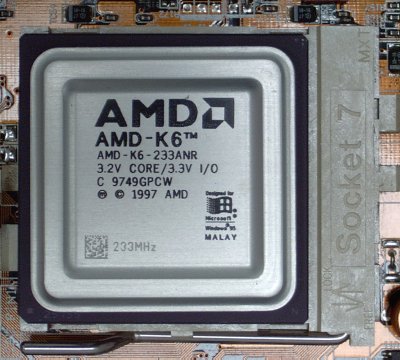
AMD-K6

The K6 supported Intel’s MMX Technology, including 57 new x86 instructions designed to enhance and accelerate multimedia software. Like the Pentium Pro, the K6 owed a great deal to classic Reduced Instruction Set Computer (RISC) designs. Using AMD’s RISC86 superscalar microarchitecture, the chip decoded each x86 instruction into a series of simpler operations that could then be processed using typical RISC principles – such as out-of-order execution, register renaming, branch prediction, data forwarding and speculative execution.

The K6 was launched in 166MHz, 200MHz and 233MHz versions. Its level of performance was very similar to a similarly clocked Pentium Pro with its maximum 512KB Level 2 cache. In common with Cyrix’s MX chip – but to a somewhat lesser extent – floating-point performance was an area of relative weakness compared with Intel’s Pentium Pro and Pentium II processors. However, the processor’s penetration of the marketplace in late 1997/early 1998 was hampered by problems AMD had in migrating its new 0.25-micron manufacturing process from its development labs to its manufacturing plant. As well as causing a shortage of 200MHz and 233MHz parts, this also delayed the introduction of 266MHz chip and the cancellation of the 300MHz chip.

  • AMD K6
  • AMD K6-2
  • AMD 3DNow
  • AMD K6-3
  • AMD Athlon
  • AMD 750 Chipset
  • AMD Thunderbird
  • AMD Duron
  • AMD Palomino
  • AMD Morgan
  • AMD Thoroughbred
  • AMD Barton
  • AMD HyperTransport
  • AMD Hammer
  • AMD Athlon 64
  • AMD Sempron
  • AMD Athlon 64 X2
  • AMD Socket AM2
  • Barcelona, AMD’s native Quad Core CPU

Filed Under: AMD technology Tagged With: AMD K6

Latest Articles

Access Quickbooks Remotely

3 Methods for Remote Quickbooks Access

Quickbooks is one of the most popular accounting packages for small business. But, people who are in charge of keeping the books do not want to always be tied to a computer working on their financials. Therefore, there are some remote access alternatives they should be aware of. This article will … [Read More...]

Disk Defrag

Video Covering Disk Defrag - Part of our Fix Slow Computer tutorial found on  https://www.pctechguide.com/how-to-fix-your-slow-computer Transcription from Video: Hi, this is Jacob with pctechguide.com, and this is Part 5 of our Why is my Computer Slow series. And in each one of these series … [Read More...]

HR Software Market to Reach $30 Billion as New Solutions Introduced

The market for HR software applications is growing at a tremendous pace. One study predicts that the market will be worth $30 billion by 2025. The benefits of HR software are indisputable, as a growing number of companies are starting to recognize the need to use more efficient options to manage … [Read More...]

Top Taplio Alternatives in 2025 : Why MagicPost Leads for LinkedIn Posting ?

LinkedIn has become a strong platform for professionals, creators, and businesses to establish authority, grow networks, and elicit engagement. Simple … [Read More...]

Shocking Cybercrime Statistics for 2025

People all over the world are becoming more concerned about cybercrime than ever. We have recently collected some statistics on this topic and … [Read More...]

Gaming Laptop Security Guide: Protecting Your High-End Hardware Investment in 2025

Since Jacob took over PC Tech Guide, we’ve looked at how tech intersects with personal well-being and digital safety. Gaming laptops are now … [Read More...]

20 Cool Creative Commons Photographs About the Future of AI

AI technology is starting to have a huge impact on our lives. The market value for AI is estimated to have been worth $279.22 billion in 2024 and it … [Read More...]

13 Impressive Stats on the Future of AI

AI technology is starting to become much more important in our everyday lives. Many businesses are using it as well. While he has created a lot of … [Read More...]

Graphic Designers on Reddit Share their Views of AI

There are clearly a lot of positive things about AI. However, it is not a good thing for everyone. One of the things that many people are worried … [Read More...]

Guides

  • Computer Communications
  • Mobile Computing
  • PC Components
  • PC Data Storage
  • PC Input-Output
  • PC Multimedia
  • Processors (CPUs)

Recent Posts

Search Google Drive with Cortana

Windows 10’s Cortana is billed as the next generation of digital assistants, bringing a whole suite of capabilities to the fore in an attempt to … [Read More...]

Installing a SCSI device – making the connections

Squeeze either side of the connector to connect the supplied SCSI cable to the SCSI host adapter card's external SCSI connector. Connect the … [Read More...]

HP Color LaserJet CM2320nf Laser Multifunction Printer

The HP Color LaserJet CM2320nf Laser Multifunction Printer can print 21 pages per minute or around 1 page every 3 seconds. This is an all-in-one … [Read More...]

[footer_backtotop]

Copyright © 2026 About | Privacy | Contact Information | Wrtie For Us | Disclaimer | Copyright License | Authors