pctechguide.com

  • Home
  • Guides
  • Tutorials
  • Articles
  • Reviews
  • Glossary
  • Contact

Optical Mice

Early optical mice used an infrared LED to detect the movement the mouse pad, rather relying on the traction between the mouse ball and the rollers. While this type of mouse was more accurate than an optical mechanical mouse, and avoided the maintenance problems associated with the moving parts of an optical mechanical mouse, it did have its drawbacks. The most obvious one was reliance on a special grid-patterned mouse pad. Another was that performance could be compromised by bright lights.

As computing power grew cheaper, it became possible to embed more powerful special-purpose image processing chips in the mouse. This advance enabled the mouse to detect relative motion on a wide variety of surfaces, translating the movement of the mouse into the movement of the pointer, eliminating the need for a special mouse pad. This advance paved the way for widespread adoption of optical mice.

1999 saw the introduction of the most radical mouse design advancement since its first appearance way back in 1968 with the introduction of Microsoft’s revolutionary Intellieye technology, which was completely dependent on optical navigation technology and capable to working on virtually any surface. Gone were the mouse ball and other moving parts inside the mouse used to track the mouse’s mechanical movement, replaced by a tiny CMOS optical sensor – the same chip used in digital cameras – and an on-board digital signal processor (DSP).
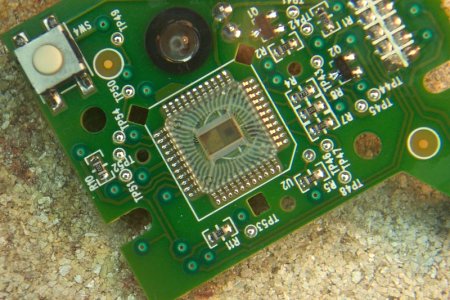
IntelliEye

In optical mice a LED illuminates the surface underneath the mouse. The light from the LED reflects off microscopic textural features in the area of traverse, a plastic lens collecting the reflected light and forming images on a sensor. The original Microsoft IntelliMouse Explorer was capable of capturing 1,500 images a second. Executing of the order of 18 million MIPS, a DSP identifies and compares texture or other features in captured images to determine the mouse’s motion and translates this into X and Y co-ordinates to indicate on-screen pointer movements.

The technique, called image correlation processing, results in smoother, more precise pointer movement. Moreover, the absence of moving parts means the mouse’s traditional enemies – such as food crumbs, dust and grime – are all but completely avoided. Optical mice work on nearly any surface, such as wood, paper, and cloth – although they do have some difficulty with reflective surfaces, such as CD jewel cases, mirrors and glass.

A year after Microsoft’s launch of the IntelliMouse Explorer, rival Logitech followed suit with the release of its first optical mouse, the Logitech Optical MouseMan Wheel. By 2001, Microsoft had further developed its IntelliEye technology, managing to increase its image capture rate fourfold, to a staggering 6,000 images a second.

  • Keyboards
  • Ergonomic Keyboards
  • Opto-Mechanical mice
  • Optical Mice
  • Cordless Input Devices
  • Laser Mice
  • Trackballs
  • Joysticks
  • Input Device Interfaces
  • Touchscreens

Filed Under: Input Devices

Latest Articles

Armored Warfare

Armored Warfare Armored Warfare is a free-to-play multiplayer tank game Obsidian. You have a wide range of games modes, maps and different tanks to choose from. What separates this from many other tank games is it's a bit more modern in the tanks you can operate. You can do player verses … [Read More...]

TFT LCD Monitors

Many companies have adopted Thin Film Transistor (TFT) technology to improve colour screens. In a TFT screen, also known as active matrix, an extra matrix of transistors is connected to the LCD panel - one transistor for each colour (RGB) of each pixel. These transistors drive the … [Read More...]

Kill Running Process on Computer

Method #1: There are many ways to kill an active process, and in this article we will examine some of the most common and effective approaches to achieve this task. When deciding to end a process, especially during a time when your system is compromised with a malware infection, be sure that you are … [Read More...]

Top Taplio Alternatives in 2025 : Why MagicPost Leads for LinkedIn Posting ?

LinkedIn has become a strong platform for professionals, creators, and businesses to establish authority, grow networks, and elicit engagement. Simple … [Read More...]

Shocking Cybercrime Statistics for 2025

People all over the world are becoming more concerned about cybercrime than ever. We have recently collected some statistics on this topic and … [Read More...]

Gaming Laptop Security Guide: Protecting Your High-End Hardware Investment in 2025

Since Jacob took over PC Tech Guide, we’ve looked at how tech intersects with personal well-being and digital safety. Gaming laptops are now … [Read More...]

20 Cool Creative Commons Photographs About the Future of AI

AI technology is starting to have a huge impact on our lives. The market value for AI is estimated to have been worth $279.22 billion in 2024 and it … [Read More...]

13 Impressive Stats on the Future of AI

AI technology is starting to become much more important in our everyday lives. Many businesses are using it as well. While he has created a lot of … [Read More...]

Graphic Designers on Reddit Share their Views of AI

There are clearly a lot of positive things about AI. However, it is not a good thing for everyone. One of the things that many people are worried … [Read More...]

Guides

  • Computer Communications
  • Mobile Computing
  • PC Components
  • PC Data Storage
  • PC Input-Output
  • PC Multimedia
  • Processors (CPUs)

Recent Posts

The Different Types of CRT Monitors – From ShortNeck to FST

By the beginning of 1998 15in monitors were gradually slipping to bargain-basement status, and the 17in size, an … [Read More...]

FED Flat Panels

Some believe FED (field emission display) technology will be the biggest threat to LCD's dominance in the panel display … [Read More...]

Control Usage of Endpoint USB Ports: Minimize Data Breaches

Data breach is a serious problem for all SMEs, irrespective of their size. The average total cost per breach has increased from $3.54 million in 2006 … [Read More...]

[footer_backtotop]

Copyright © 2026 About | Privacy | Contact Information | Wrtie For Us | Disclaimer | Copyright License | Authors