pctechguide.com

  • Home
  • Guides
  • Tutorials
  • Articles
  • Reviews
  • Glossary
  • Contact

Flat panel displays for mobile computers – laptops, notebooks and netbooks

In the portable arena the dramatic weight, size and power consumption benefits of LCD technology has, for several years, outweighed their relative high cost. By the late 1990s notebook screen sizes had topped out at around 15in and two designs had achieved a position of dominance over earlier, less efficient techniques:

  • dual scan (DSTN), and
  • thin film transistor (TFT).

The former – which controls the LCD elements via passive matrix addressing – consumes less power and is considerably less expensive than its rival technology. TFT’s active matrix design, however, is capable of significantly superior display performance.

The two designs share the same basic principles of operation and construction, both working by the polarisation of light. LCDs are a transmissive display technology, relying on a backlight to produce light which is then selectively blocked by other components. This is generally a set of low-voltage fluorescent tubes, arranged so that they spread light across the display as evenly as possible, usually with the aid of a diffusing filter. These produce pure white light and run at several kHz to eliminate flicker. This light passes through a sandwich of glass, liquid crystals and polarising filters. Liquid crystals twist when a voltage is applied to them, and this twisting changes the polarisation of the light passing through. The first polarising filter ensures that light going into the liquid crystal is polarised in one direction only. Row and column electrodes allow the display’s electronics to turn any pixel fully on, fully off, or be set to any value in between. The liquid crystals alter the polarisation of the light in proportion to the voltage applied to liquid crystal mixture. With a red, green and blue element for each pixel, a colour filter is able to produce the appropriate colour of the spectrum for each displayed pixel. Depending on the amount of twist applied by the liquid crystal, the second polarising filter blocks some or none of the light passing through.
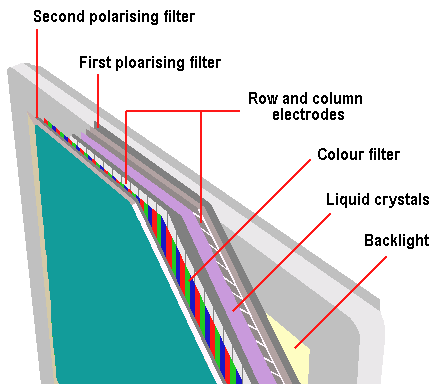
LCD

DSTN and TFT LCDs – together with a number of other emerging display technologies – are covered in detail in the flat panel display guide.

  • Flat panel displays for mobile computers – laptops, notebooks and netbooks
  • Battery technology for mobile computers – laptops, notebooks and webbooks
  • Laptop, notebook and netbook expansion devices
  • Expansion interfaces for laptops, notebooks and other mobile computers
  • DynaSheet
  • External keyboards for mobile computers.
  • USB On-The-Go – USB technology for PDAs and mobile phones
  • Guide to Kensington Slot (K-lock, Kensington Lock, Universal Security Lock) mobile device security

Filed Under: Mobile Computing Components Tagged With: laptop display, laptop monitor, lcd monitor, lcd screen, liquid crystal display, mobile computer display, notebook display, notebook monitor

Latest Articles

DVD-ROM

Like DVD discs, there is little to distinguish a DVD-ROM drive from an ordinary CD-ROM drive as the only giveaway is the DVD logo on the front. Even inside the drive there are more similarities than differences: the interface is ATAPI or … [Read More...]

Pentium Roadmap

The table below presents the anticipated roadmap of future Intel mainstream desktop processor developments. Note that currently there is no public roadmap information for Pentium developments beyond H1 2007. This page will be updated when the data becomes available, though of course the … [Read More...]

Registry Mechanic Review

Registry Mechanic is considered as one of the most renowned registry utilities that are currently available in the market. Once you install it in your system and launch it, a decent looking interface will appear on the screen with large buttons that are labeled clearly. While running … [Read More...]

Everything You Need to Know About Sourcing Circuit Boards From U.S. Suppliers

In This Article This article includes: Why Source PCBs From the United States?How to Get a Quote From a U.S.-Based PCB ManufacturerThe Top U.S. … [Read More...]

Top Taplio Alternatives in 2025 : Why MagicPost Leads for LinkedIn Posting ?

LinkedIn has become a strong platform for professionals, creators, and businesses to establish authority, grow networks, and elicit engagement. Simple … [Read More...]

Shocking Cybercrime Statistics for 2025

People all over the world are becoming more concerned about cybercrime than ever. We have recently collected some statistics on this topic and … [Read More...]

Gaming Laptop Security Guide: Protecting Your High-End Hardware Investment in 2025

Since Jacob took over PC Tech Guide, we’ve looked at how tech intersects with personal well-being and digital safety. Gaming laptops are now … [Read More...]

20 Cool Creative Commons Photographs About the Future of AI

AI technology is starting to have a huge impact on our lives. The market value for AI is estimated to have been worth $279.22 billion in 2024 and it … [Read More...]

13 Impressive Stats on the Future of AI

AI technology is starting to become much more important in our everyday lives. Many businesses are using it as well. While he has created a lot of … [Read More...]

Guides

  • Computer Communications
  • Mobile Computing
  • PC Components
  • PC Data Storage
  • PC Input-Output
  • PC Multimedia
  • Processors (CPUs)

Recent Posts

VCD Digital Video

The VideoCD format was created to satisfy the demands of both the entertainment and information publishing worlds. The aim … [Read More...]

10 tips to avoid ransomware

Cybersecurity threats are costly nightmares. According to the FBI's 2020 Internet Crime Report, ransomware attacks in the United States alone cost … [Read More...]

Environmental Issues

Unfortunately, the technology used in laser printers makes ozone an inherent by-product of the printing process. The … [Read More...]

[footer_backtotop]

Copyright © 2026 About | Privacy | Contact Information | Wrtie For Us | Disclaimer | Copyright License | Authors