pctechguide.com

  • Home
  • Guides
  • Tutorials
  • Articles
  • Reviews
  • Glossary
  • Contact

NetBurst – Pentium 4 7th generation x86 CPU microarchitecture

NetBurst is the name Intel gave to the new architecture that succeeded its P6 microarchitecture. The concept behind NetBurst was to improve the throughput, improve the efficiency of the out-of-order execution engine, and to create a processor that can reach much higher frequencies with higher performance relative to the P5 and P6 microarchitectures, while maintaining backward compatibility.

Initially launched in Intel’s seventh-generation Pentium 4 processors (the Willamette core) in late 2000, the NetBurst architecture represented the biggest change to the IA-32 architecture since the Pentium Pro in 1995. One of the most important changes was to the processor’s internal pipeline, referred to as Hyper Pipeline. This comprised 20 pipeline stages versus the ten for the P6 microarchitecture and was instrumental in allowing the processor to process more instructions per clock and to operate at significantly higher clock speeds than its predecessor.
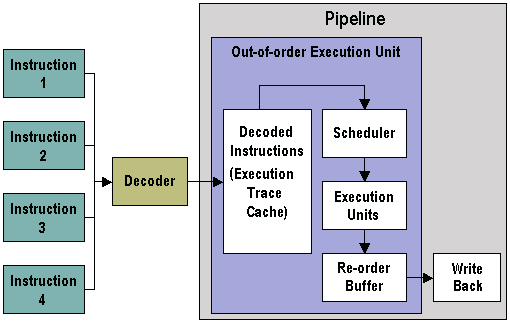
NetBurst

The NetBurst microarchitecture has only one decoder (as opposed to the three in the P6 microarchitecture), and the out of order execution unit now has the execution trace cache that stores decoded ops. The core’s ability to execute instructions out of order remains a key factor in enabling parallelism, several buffers being employed to smooth the flow of ops, and longer pipelines and the improved out-of-order execution engine allow the processor to achieve higher frequencies, and improve throughput.

Ultimately, the NetBurst microarchitecture was to prove to be something of a disappointment in comparison to Intel’s mobile-processor technology. It was therefore not entirely surprising when it transpired that NetBurst’s successor would build on the energy-efficient philosophy adopted in Intel’s mobile microarchitecture and embodied in its Pentium M family of processors.

  • Principles of CPU architecture – logic gates, MOSFETS and voltage
  • Basic structure of a Pentium microprocessor
  • Microprocessor Evolution
  • IA-32 (Intel Architecture 32 ) – base instruction set for 32 bit processors
  • Pentium P5 microarchitecture – superscalar and 64 bit data
  • Pentium Pro (P6) 6th generation x86 microarchitecture
  • Dual Independent Bus (DIB) – frontside and backside data bus CPU architecture
  • NetBurst – Pentium 4 7th generation x86 CPU microarchitecture
  • Intel Core – 8th generation CPU architecture
  • Moore’s Law in IT Architecture
  • Architecture Manufacturing Process
  • Copper Interconnect Architecture
  • TeraHertz Technology
  • Software Compatibility
  • IA-64 Architecture
  • Illustrated guide to high-k dielectrics and metal gate electrodes

Filed Under: CPU Architecture Tagged With: 7th generation x86, NetBurst architecture, Pentium 4 architecture, Pentium 4 NetBurst

Latest Articles

Change Power Setting

Edit and Create Power Profile in Windows 7

Different computers have different power needs. Sometimes a computer may need its full resources most of the time so it needs full power. On the other hand, other computers may be able to get by with limited power. Furthermore, the type of computer can play a role. A laptop, for example, may need to … [Read More...]

Pentium Architecture

The Pentium's CISC-based architecture represented a leap forward from that of the 486. The 120MHz and above versions have over 3.3 million transistors, fabricated on a 0.35-micron process. Internally, the processor uses a 32-bit bus but … [Read More...]

Keep Your Employees Working During a Disaster

Any business owner has probably heard of preparing for a disaster when it comes to IT. They probably know about backups and keeping data safe. They may even know about disaster recovery and making sure there is a fall back site to place the data. But, there is one area that is often neglected. What … [Read More...]

Why Internet Bundles Are the Next Battleground for Gamers

A weak internet connection can turn seamless gaming sessions into frustrating experiences filled with lag, buffering or sudden disconnects. For … [Read More...]

Importance of Inbound Marketing in the Digital Age

A couple of months ago, Zacks reported that Hubspot was starting to make some major changes to its inbound marketing strategy. They talk a lot about … [Read More...]

Damage Control Strategies for Resolving Online PR Crises

Last July, Astrologer faced a major crisis after its CEO went viral at a ColdPlay concert when having an affair. This was just one of the many times a … [Read More...]

AI is Not Killing Computer Jobs Like Doomers Projected

There is no denying the reality that AI technology has played a massive role in disrupting our lives. A growing number of people claim that AI … [Read More...]

Everything You Need to Know About Sourcing Circuit Boards From U.S. Suppliers

In This Article This article includes: Why Source PCBs From the United States?How to Get a Quote From a U.S.-Based PCB ManufacturerThe Top U.S. … [Read More...]

Top Taplio Alternatives in 2025 : Why MagicPost Leads for LinkedIn Posting ?

LinkedIn has become a strong platform for professionals, creators, and businesses to establish authority, grow networks, and elicit engagement. Simple … [Read More...]

Guides

  • Computer Communications
  • Mobile Computing
  • PC Components
  • PC Data Storage
  • PC Input-Output
  • PC Multimedia
  • Processors (CPUs)

Recent Posts

Celeron Covington

The first Celerons (codenamed Covington) were essentially a Pentium IIs manufactured without any Level 2 cache at all. … [Read More...]

Phase Change Technology

Panasonic's PD system, boasting the company's own patented phase-change technology, has been around since late 1995. … [Read More...]

Safety Standards For Computer Monitors

In the late 1980s concern over possible health issues related to monitor use led Swedac, the Swedish testing authority, … [Read More...]

[footer_backtotop]

Copyright © 2026 About | Privacy | Contact Information | Wrtie For Us | Disclaimer | Copyright License | Authors