In late 1995 a joint university/industry/government consortium initiated the Holographic Data Storage System (HDSS) programme, with the initial goals of developing several key components for the system, including a high-capacity, high-bandwidth spatial light modulator used for data input; optimised sensor arrays for data output; and a high-power red-light, semiconductor laser. At the same time, the HDSS researchers were to explore issues relating to the optical systems architecture (such as multiplexing schemes and access modes), data encoding/decoding methods, signal processing techniques, and the requirements of target applications. Into the programme’s final year, progress has been such that consortium member – IBM Research Division – believed that holograms could hold the key to high-capacity data storage in the next millennium.
In holographic data storage, an entire page of information is stored at once as an optical interference pattern within a thick, photosensitive optical material. Therein lie the reasons why holographic data storage is able to both break through the density limits of conventional storage and achieve data transfer rates significantly higher than current optical storage devices:
- unlike other technologies that record one data bit at a time, holography allows a million bits of data to be written and read in parallel with a single flash of light, and
- it is by going beyond recording only on the surface, to recording through the full depth of the medium that holographic data storage is able to break through the density limits of conventional storage.
The combination of high storage densities, fast transfer rates, with durable, reliable, low cost media, make holography poised to become a compelling choice for next-generation storage solution to the data archival requirements of the commercial, medical, governmental and broadcast industries.
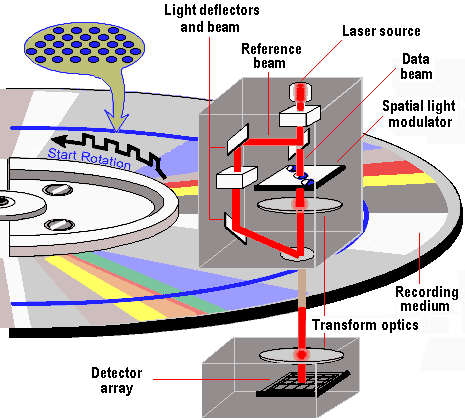
Holographic storage uses two laser beams, a reference and a data beam to create an interference pattern at a medium where the two beams intersect. This intersection causes a stable physical or chemical change which is stored in the medium. This is the write sequence. During reading, the action of the reference beam and the stored interference pattern in the medium recreates this data beam which may be sensed by a detector array. The medium may be a rotating disk containing a polymeric material, or an optically sensitive single crystal.
Tokyo-based Optware Corporation, a leading developer of Holographic Versatile Disc (HVD) storage products, has developed a system – referred to as collinear holography – in which the reference and information beams are handled as a pencil of coaxial light, rather than the two-beam interference method widely used in the past. This breakthrough mechanism has led to a dramatic simplification and downsizing of the previously bulky and complicated systems required to generate holograms, and in early 2005 ECMA created a technical committee to develop a standardisation strategy for Holographic Information Storage (HIS) systems, that was initially based upon Optware’s Collinear Technologies.
One of the major challenges in the area of holographic data storage has been the development of suitable storage materials. Holographic media must satisfy stringent criteria, including high dynamic range, high photosensitivity, dimensional stability, optical clarity and flatness, non-destructive readout, millimetre thickness, and environmental and thermal stability. Many groups centred in large commercial research organisations had looked at this problem, and most had given up without success.
However, one of those that that persevered was InPhase Technologies, founded in December 2000 as a Lucent Technologies venture, spun out of Bell Labs research. Eventually, their efforts were to bear fruit, with the development of a new class of photopolymer materials which satisfied the criteria for a commercial viability, and which was to lead to a successful public demonstration of a prototype of the very first holographic data storage drive, during 2005.
Typical photopolymers use a single chemistry for bonding molecules together to form the media and to perform the recording. The InPhase polymer system utilises materials that use two distinct chemistries that are independent yet compatible. One chemistry is used to form the media and to control the mechanical, manufacturing, and archive life parameters. The second chemistry is used during the recording process. These two chemistries do not interact or interfere with each other, thus enabling high dynamic range with extremely good dimensional stability during recording.
Dubbed the Tapestry Drive, the first commercial units are expected to be delivered to OEMs in October 2006. The first drives in the family will be WORM devices with a capacity of 300GB on a single 12cm removable disk. InPhase expect to increase this to 800GB in late 2007 and to 1.6TB in 2010. All this family of drives will be fully backward compatible.
- Floppy Disk Data Storage
- Optical drives – WORM Write Once Read Many technology
- Magnetic Disk Technology
- Magneto-optical drives – MO technology
- LIMDOW Data Storage
- MO Media
- OSD Data Storage Technology
- Florescent Disc Technology
- Phase Change Technology
- Floppy Disc Replacements
- Super Floppies
- Hard Disk Compliment
- Tape Storage Compatibility
- Holographic Data Storage