By early 2000 a revolution was underway in an entirely new form of peer-to-peer computing. Sparked by the phenomenal success of a number of highly publicised applications, P2P computing - as it is … [Continue reading]
Client-Server Architecture
Client-server networking architectures became popular in the late 1980s and early 1990s as many applications were migrated from centralised minicomputers and mainframes to networks of personal computers. … [Continue reading]
Peer to Peer Network Architecture
In a Peer-to-peer networking architecture each computer (workstation) has equivalent capabilities and responsibilities. There is no server, and computers simply connect with each other in a workgroup … [Continue reading]
Gigabit Ethernet

The next step in Ethernet's evolution was driven by the Gigabit Ethernet Alliance, formed in 1996. The ratification of associated Gigabit Ethernet standards was completed in the summer of 1999, specifying a physical layer that uses a mixture of … [Continue reading]
Fast Ethernet
Fast Ethernet was officially adopted in the summer of 1995, two years after a group of leading network companies had formed the Fast Ethernet Alliance to develop the standard. Operating at ten times … [Continue reading]
Ethernet
Ethernet was developed in the mid 1970s by the Xerox Corporation, and in 1979 Digital Equipment Corporation DEC) and Intel joined forces with Xerox to standardize the system. The first specification by the three companies called the Ethernet Blue … [Continue reading]
Token Ring Networks

In 1984, IBM introduced the 4 Mbit/s Token Ring network. Instead of the normal plug and socket arrangement of male and female gendered connectors, the IBM data connector (IDC) was a sort of hermaphrodite, … [Continue reading]
FDDI Networking
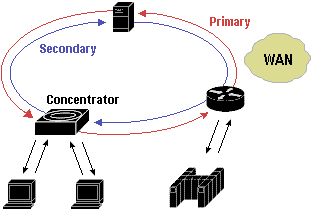
Developed by the American National Standards Institute (ANSI) standards committee in the mid-1980s - at a time when high-speed engineering workstations were beginning to tax the bandwidth of … [Continue reading]
Network Topologies
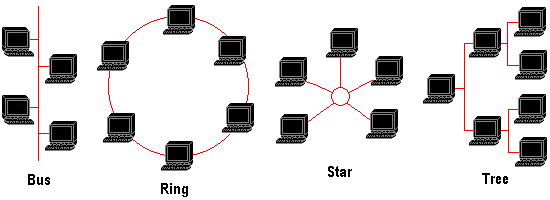
LAN topologies define the manner in which network devices are organized. Four common LAN topologies exist: A bus topology is a linear LAN architecture in which transmissions from network stations propagate … [Continue reading]
OSI Model
The Open Systems Interconnection (OSI) reference model describes how information from a software application in one computer moves through a network medium to a software application in another … [Continue reading]