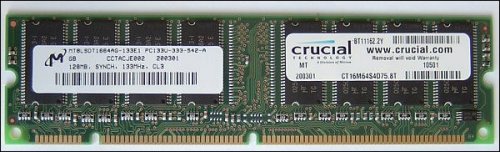
By the end of the millennium, as memory subsystems standardised around an 8-byte data interface, the Dual In-line Memory Module (DIMM) had replaced the SIMM as the module standard for the PC … [Continue reading]
By the end of the millennium, as memory subsystems standardised around an 8-byte data interface, the Dual In-line Memory Module (DIMM) had replaced the SIMM as the module standard for the PC … [Continue reading]
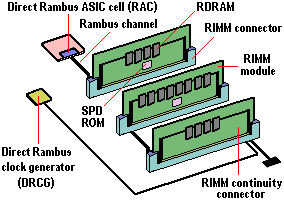
With the introduction of Direct RDRAM (DRDRAM) in 1999 came the RIMM module (the name is not an acronym, but a trademark of Rambus Inc.). RIMM connectors have a form factor similar to DIMMs … [Continue reading]
When a computer system boots up, it must detect the configuration of the memory modules in order to run properly. For a number of years, Parallel Presence Detect (PPD) was the traditional method … [Continue reading]
Memory modules have traditionally been available in two basic flavours: non-parity and parity. Parity checking uses a ninth memory chip to hold checksum data on the contents of the other eight … [Continue reading]
Unlike parity memory, which uses a single bit to provide protection to eight bits, ECC uses larger groupings. Five ECC bits are needed to protect each eight-bit word, six for 16-bit words, seven … [Continue reading]
In recent times, as well as becoming much cheaper, RAM has also become more complicated. There are currently a proliferation of different varieties, shapes and voltages. The first step in planning … [Continue reading]
In the late 1990s, PC users have benefited from an extremely stable period in the evolution of memory architecture. Since the poorly organised transition from FPM to EDO there has been a … [Continue reading]
Flash memory is a solid-state, non-volatile, rewritable memory that works like RAM and a hard-disk drive combined. It resembles conventional memory, coming in the form of discrete chips, modules, or memory cards such as those made by Memory … [Continue reading]
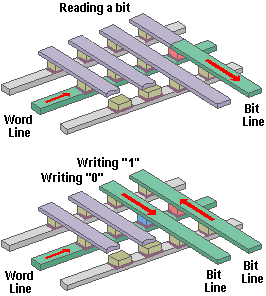
In late 2000 IBM and German semiconductor company Infineon Technologies AG announced plans to collaborate in the development of Magnetic Random Access Memory (MRAM) - a breakthrough memory technology that … [Continue reading]
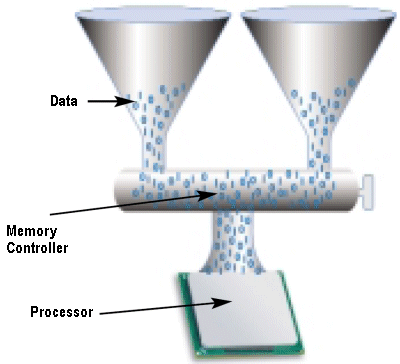
The terminology dual-channel DDR is, in fact, a misnomer. The fact is there's no such thing as dual-channel DDR memory. What there are, however, are dual-channel platforms. When properly used, the … [Continue reading]