PCI-X v1.0, a high performance addendum to the PCI Local Bus specification co-developed by IBM, Hewlett-Packard, and Compaq - normally competitors in the PC server market - was unanimously approved by the Peripheral … [Continue reading]
Internal Interfaces Summary
The following table summarises the various interface standards for internal host adapter cards, in use as at mid-1998: Standard Typical uses Burst DTR Outlook ISA Sound cards, modems 2 MBps to 8.33 … [Continue reading]
What is AGP and AGP Pro?

As fast and wide as the PCI bus was, there was one task that threatened to consume all its bandwidth: displaying graphics. Early in the era of the ISA bus, monitors were driven by simple Monochrome Display adapter (MDA) and Colour Graphics … [Continue reading]
PCI Bus Interfaces
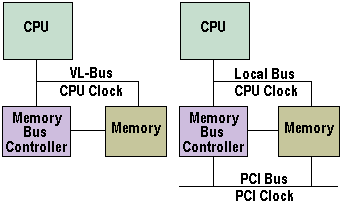
Intel's original work on the PCI standard was published as revision 1.0 and handed over to a separate organisation, the PCI SIG (Special Interest Group). The SIG produced the PCI Local Bus … [Continue reading]
Local Bus Interfaces
Intel 80286 motherboards were capable of running expansion slots and the processor at different speeds over the same bus. However, dating from the introduction of the 386 chip in 1987, motherboards … [Continue reading]
ISA Bus – Industry Standard Architecture
When it appeared on the first PC the 8-bit ISA bus ran at a modest 4.77MHz - the same speed as the processor. It was improved over the years, eventually becoming the Industry Standard Architecture (EISA), developed by a consortium made up of … [Continue reading]
What Is The System Bus?

A modern-day system can be viewed as comprising just two classes of bus: a System Bus, connecting the CPU to main memory and Level 2 cache, and a number of I/O Busses, connecting various peripheral devices to the CPU - the latter being … [Continue reading]
1T SRAM
Historically, while much more cost effective than SRAM per Megabit, traditional DRAM has always suffered speed and latency penalties making it unsuitable for some applications. Consequently, product manufacturers … [Continue reading]
Direct DRAM
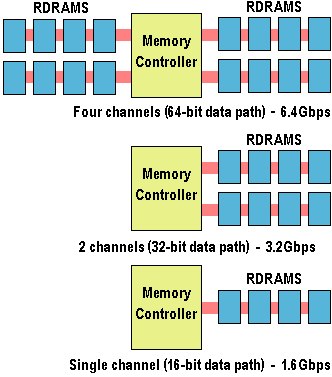
Conventional DRAM architectures have reached their practical upper limit in operating frequency and bus width. With mass market CPUs operating at over 300MHz and media processors executing more than … [Continue reading]
SIMMs
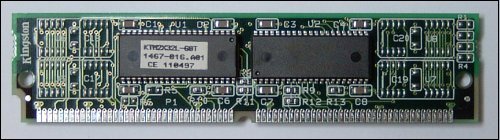
Memory chips are generally packaged into small plastic or ceramic dual inline packages (DIPs) which are themselves assembled into a memory module. The single inline memory module or SIMM is a … [Continue reading]