In-Plane Switching (IPS) was one of the first refinements to produce significant gains in the light-transmissive characteristics of TFT panels. Jointly developed by Hosiden and NEC, it is a technology that addresses the two main issues of a standard twisted nematic (TN) TFT display: colour and viewing angle.
With IPS, the crystals are aligned horizontally to the screen rather than vertically, and the electrical field is applied between each end of the crystal molecules – termed a lateral electric field. In this way, the crystals are kept parallel to the the electrode pair, and thus the glass substrate of the screen. The liquid crystal molecules are not anchored to the lower glass substrate, so move more freely into the desired alignment.
Comparing TN and IPS Light Flow Through LCD Monitors
In a TN TFT display when one end of the liquid crystal is anchored to the lower glass substrate and a voltage is applied, the crystal compounds untwist, changing the angle of polarisation of the transmitted light. A downside of basic TN technology is that the alignment of molecules of liquid crystal alters the further away they are from the anchored electrode, turning at right angles to the substrates. This impairs the flow of light causing diminishing contrast, brightness and colour definition at wider angles to the screen.
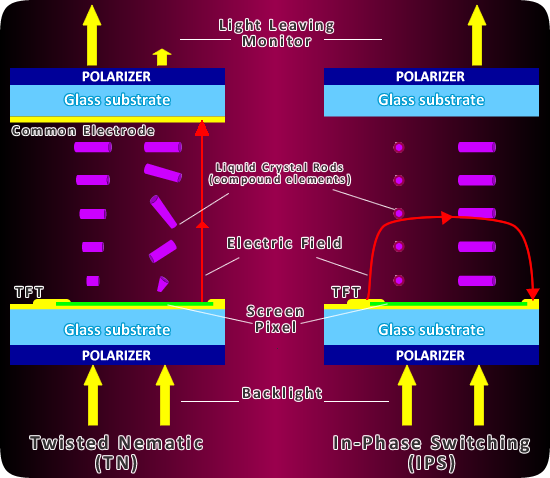
IPS improves viewing angles of TFT monitors considerably, but means that two transistors are needed for every pixel, instead of the one needed for a TN TFT display. Using two transistors means that more of the transparent area of the display is blocked from light transmission, so brighter backlights must be used. The increased power consumption can make the displays unsuitable for notebook use, but in higher end, particularly multimedia focussed notebooks with widescreen movie viewing as a principle purpose IPS screens are employed. Wide angle viewing is certainly enjoyed, but the price is that battery life may be poor.
However, digital video and mobile TV has grown in popularity, and is of course commonly viewed on very small screen displays such as handheld cameras, mobile phones, handheld computers and PDAs. Since the size of these screens is so small, perhaps only 2 to 4 inches in width, front viewing isn’t possible for more than one person, so they need a wide angle of display. Although not the only solution employed, IPS has been adopted in many such devices, particulary by Hitachi who have consistently been one of the technology’s major adopters and innovators.
Evolution of IPS LCD Technology
Since its introduction in 1996 IPS has gone through a number of advances, with stages of Super IPS, Advanced Super IPS, and IPS-Pro. The following table shows the improvements made in each development stage of the technology.
| Name | IPS | S-IPS | AS-IPS | IPS-Pro |
|---|---|---|---|---|
| Year | 1996 | 1998 | 2002 | 2004 |
| Main advance | Wide viewing angle | Colour shift free | High transmittance | High contrast ratio |
| Transmittance | 100 | 100 | 130 | 156 |
| Contrast Ratio | 100 | 137 | 250 | 313 |
| Plane View of Electrode Structure and LC Molecules |  |
 |
 |
 |
| Enlarged front view of a pixel |  |
 |
 |
 |
Super IPS was introduced in 1998 to combat the colour shift that was still apparent in wide angles of the original IPS screens. With AS-IPS the breakthrough was to move from opaque to transparent electrodes, considerably reducing the amount of power required for an IPS backlight. Also notice the transition to more smooth pixels, giving a cleaner, crisper more continuous image at all angles.
IPS-Pro is highly advanced and very expensive, only used in industrial settings where image clarity on a screen is considered critical. Commonly IPS-Pro is used in medical settings, particularly in surgery, but there are other uses in advanced engineering and science that benefit from the clarity and precision of IPS-Pro.
- VA – Vertically Aligned LCD Monitors
- What in the LCD is IPS!?
- ThinCRT Flat Panels
- TFT LCD Monitors
- LCD Resolutions and Picture Scaling
- Liquid Crystal Light Polarisation in LCD Monitors
- Polysilicon Flat Panels
- Plasma Flat Panels
- PALCD Flat Panels
- OLED Flat Panels
- MVA – Multi-domain Vertical Alignment in LCD Monitors
- LEP Flat Panels
- LED Flat Panels
- LCD – Liquid Crystal Displays
- IPS – In-Plane Switching LCD Monitors
- HAD Flat Panels
- Flat Panel Feature Comparisons
- FED Flat Panels
- Digital Flat Panels
- DSTN LCD monitors
- Creating Colour in LCD Displays
- Flat Panel ALiS Technology
I think reference to Hosiden and NEC as initial developers of IPS is incorrect. The source of this reference is apparently a book by Amit Dhir – The Digital Consumer Technology Handbook (2004). Wikipedia and other sources credit Hitachi as the inventor of IPS, and they also introduced the first commercial panels. Major IPS panel producers are LG Displays and Hitachi, with NEC, Sony and Toshiba also producing panels in certain sizes (Sony for internal consumption only). IPS panels are widely used in medical diagnostic displays and high-end graphics monitors due to wide viewing angles with very consistent grayscale and color reproduction as compared to all other LCD technologies. Hitachi and LG now continue on separate paths to advance the technology for higher pixel density, increased light output, contrast ratio, response time and backlight power efficiency.
Please remove the annoying bar showing Tweet, f Like etc … It really blocks view and very annoying ..
what is your browser and what size screen are you viewing the site on?
YES !! Extemely annoying !!!!!!!!!!
what browser are you using and what screen resolution. Does not do it for any of sizes or browsers we tested on.
please make a video about it would extremely helpful and even more understandable