With today's hard disks measured in gigabytes, and with multimedia and graphics file sizes often measured in tens of megabytes, a capacity of 100MB to 150MB is just right for taking over the … [Continue reading]
Phase Change Technology
Panasonic's PD system, boasting the company's own patented phase-change technology, has been around since late 1995. Considered innovative at the time, the PD drive combines an optical disk drive capable of handling 650MB … [Continue reading]
Florescent Disc Technology

Another contender in the battle to become the de facto high-density storage medium for the digital world could come from US data storage specialist, C3D, in the shape of its revolutionary optical … [Continue reading]
OSD Data Storage Technology
Optical Super Density (OSD) technology's design goals were to develop a high capacity (40GB or more) removable MO drive which retained the ruggedness and reliability offered by today's ISO-standard … [Continue reading]
MO Media
An MO disk is constructed by spattering a number of films onto a high-strength polycarbonate resin substrate base - the same material as used in bullet-proof glass - and coating the entire disk … [Continue reading]
LIMDOW Data Storage
Light Intensity Modulated Direct OverWrite technology uses a different write technology which significantly improves on the performance levels of earlier MO devices and claims to be a viable alternative … [Continue reading]
Magneto-optical drives – MO technology

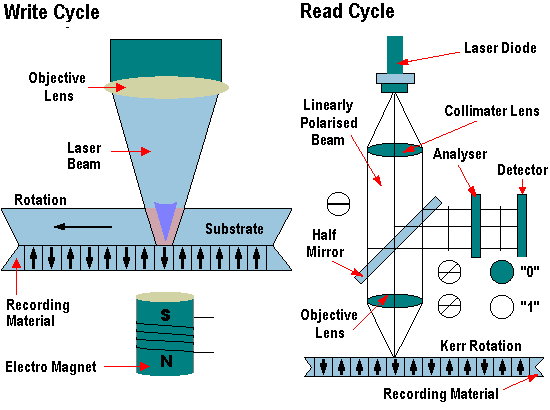
As implied by the name, these drives use a hybrid of magnetic and optical technologies, employing laser to read data on the disk, while additionally needing magnetic field to write data. An MO disk drive is so designed that an inserted … [Continue reading]
Magnetic Disk Technology
Magnetic devices like floppy disks, hard disks and some tape units all use the same underlying technology to achieve this. The media (meaning the disk as opposed to the drive) is coated with … [Continue reading]
Optical drives – WORM Write Once Read Many technology
Despite the floptical's failure to oust the traditional floppy disk, for several years it appeared likely that optical drives, which read/wrote data with lasers which are far more precise than the drive heads on a traditional hard drive, were … [Continue reading]
Floppy Disk Data Storage
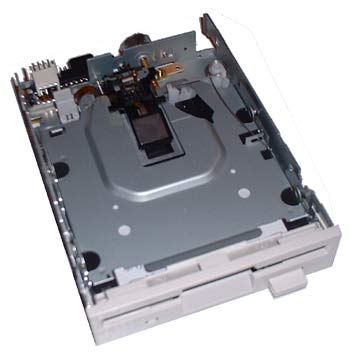
In 1967, the storage group at IBM's San Jose Laboratories was charged with developing an inexpensive device to store and ship microcode for mainframe processors and control units. The device had to … [Continue reading]