
Virtually all contemporary operating systems divide their work load up into processes and threads that can be independently scheduled and dispatched to run on a processor. The same division of … [Continue reading]
Virtually all contemporary operating systems divide their work load up into processes and threads that can be independently scheduled and dispatched to run on a processor. The same division of … [Continue reading]
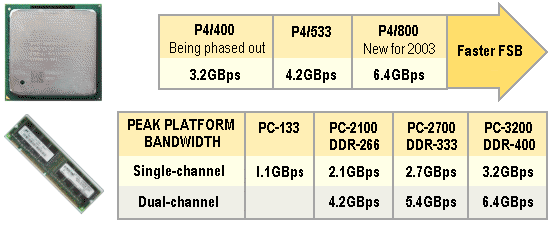
For several months after the Pentium 4 began shipping in late 2000 the leadership in the battle to have the fastest processor on the market alternated between Intel and rival AMD, with no clear … [Continue reading]
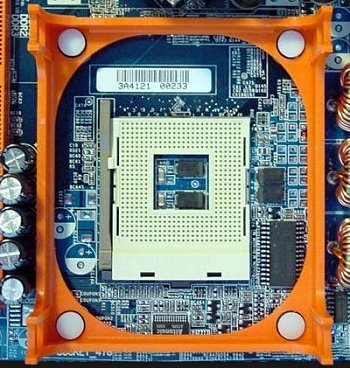
In early 2000, Intel unveiled details of its first new IA-32 core since the Pentium Pro - introduced in 1995. Previously codenamed Willamette - after a river that runs through Oregon - it was … [Continue reading]
The table below presents the anticipated roadmap of future Intel mainstream desktop processor developments. Note that currently there is no public roadmap information for Pentium developments beyond H1 2007. This page will be updated when the … [Continue reading]
It had been Intel's original intention to introduce the Tualatin processor core long before it actually did, as a logical progression of the Pentium III family that would - as a consequence of its finer … [Continue reading]
Intel's successor to the Pentium II, formerly codenamed Katmai, came to market in the spring of 1999. With the introduction of the MMX came the process called Single Instruction Multiple Data … [Continue reading]
In June 1998 Intel introduced its Pentium II Xeon processor, rated at 400MHz. Technically, Xeon represented a combination of Pentium Pro and Pentium II technology and was designed to offer outstanding performance … [Continue reading]
A 333MHz incarnation of the Pentium II, codenamed Deschutes after a river that runs through Oregon, was announced at the start of 1998, with 400MHz and higher clock speeds planned for later in the … [Continue reading]
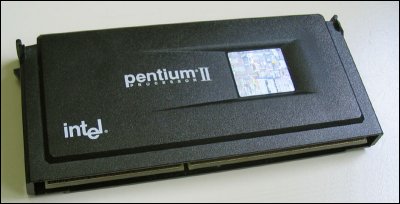
The Pentium II's Single Edge Contact cartridge technology allows the core and L2 cache to be fully enclosed in a plastic and metal cartridge. These sub-components are surface mounted directly to … [Continue reading]
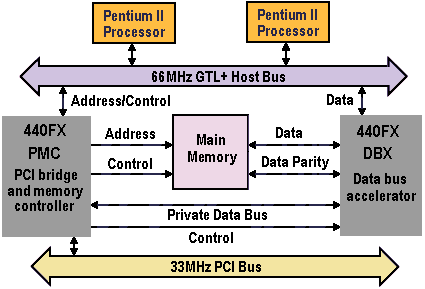
Launched in mid-1997, the Pentium II introduced a number of major changes to the processing end of the PC: First, the chip itself and the system's Level 2 cache are connected by a … [Continue reading]