In 1967, the storage group at IBM’s San Jose Laboratories was charged with developing an inexpensive device to store and ship microcode for mainframe processors and control units. The device had to cost under $5, be simple to install and replace, had to be easy to ship and needed unquestionable reliability. Existing technologies – such as the magnetic belts used in dictating machines of the time – were tried, and rejected. The proposed solution was a completely new technology, the floppy disk.
In 1971 the first incarnation of the floppy disk was incorporated into IBM’s System 370 mainframe computer. It was a read-only, 8in plastic disk coated with iron oxide, weighing just under 2 oz. and capable of storing about 80KB. A crucial part of its design was its protective enclosure, lined with a nonwoven fabric that continuously wiped the surface of the disk as it rotated to keep it clean.
In 1973, IBM released a new version of the floppy on its 3740 Data Entry System. This had a completely different recording format, the motor spun in the opposite direction and the device now boasted read/write capacity and a storage capacity of 256KB. It was then that the floppy disk market took off. In 1976 – at just about the time that personal computing was entering the scene – the 8in form factor was superseded by the 5.25in floppy. That design eventually gave way to the 3.5in diskette, developed by Sony Corp. in 1981.
The 5.25in floppy began life with a capacity of 160KB, quickly went to 180KB and then to 360KB with the advent of double-sided drives. In 1984, the 5.25in floppy maxed-out at 1.2MB. That same year, Apricot and HP launched PCs with the revolutionary Sony 3.5in 720KB disk drive. Three years down the road, this doubled in size to 1.44MB and for the past decade or so, that’s where it’s stayed. This was partly due to manufacturers’ reluctance to accept a new standard and partly due to the rapid acceptance of CD-ROM, which is a more efficient way to distribute software than floppies.
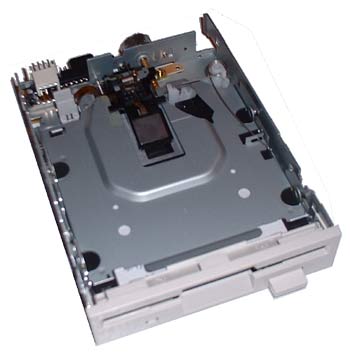
Floppy drives are notable for the use of open loop tracking: they don’t actually look for the tracks, but simply order the head to move to the correct position. Hard disk drives, on the other hand, have servo motors embedded on the disk which the head uses to verify its position, allowing track densities many hundred times higher than is possible on a floppy disk.
When a 3.5in disk is inserted, the protective metal slider is pushed aside and a magnet locks onto the disk’s metal centre plate. The drive spindle goes in the centre hole, and the drive pin engages the rectangular positioning hole next to this. The drive pin is spun by the drive motor, a flat DC servo device locked to a spin of 300rpm by a servo frequency generator.
The head is moved by a lead-screw which in turn is driven by a stepper motor; when the motor and screw rotate through a set angle, the head moves a fixed distance. The data density of floppies is therefore governed by the accuracy of the stepper motor, which means 135 tracks per inch (tpi) for 1.44MB disks. A drive has four sensors: disk motor; write-protect; disk present; and a track 00 sensor, which is basically an edge stop.
The magnetic head has a ferrite core, with the read/write head in the centre and an erase head core on either side. The erase heads wipe out a strip either side of a new data track to avoid interference from old data tracks. Bits are stored as magnetic inversions, the inversion intervals being two to four microseconds (µs). The read signal goes to a peak detector and is processed to produce a binary signal by the electronics in the drive. This is then sent back to the PC.
Over the years there have been attempts to increase the capacity of the humble floppy, but none got very far. First, there was IBM’s bid (in 1991) to foist a 2.88MB floppy standard on the PC world, using expensive barium-ferrite disks, but it never caught on. Iomega and 3M had another go in 1993 with the 21MB floptical disk; however, this wasn’t enough to grab the market’s interest and the product faded away; it was just too expensive and too small.
- Floppy Disk Data Storage
- Optical drives – WORM Write Once Read Many technology
- Magnetic Disk Technology
- Magneto-optical drives – MO technology
- LIMDOW Data Storage
- MO Media
- OSD Data Storage Technology
- Florescent Disc Technology
- Phase Change Technology
- Floppy Disc Replacements
- Super Floppies
- Hard Disk Compliment
- Tape Storage Compatibility
- Holographic Data Storage