In early 2000, chip designer Transmeta Corporation unveiled its innovative Crusoe family of x86-compatible processors aimed specifically at the mobile computing arena and designed with the objective of maximizing the battery life of mobile devices. In development since the company’s foundation in 1995, the technology underlying the Crusoe processor solution is fundamentally software-based: the power savings come from replacing large numbers of transistors with software.
The hardware component is a very long instruction word (VLIW) CPU capable of executing up to four operations in each clock cycle. The VLIW’s native instruction set bears no resemblance to the x86 instruction set; it has been designed purely for fast low-power implementation using conventional CMOS fabrication. The surrounding software layer gives x86 programs the impression that they are running on x86 hardware. The software layer is called Code Morphing software because it dynamically morphs (that is, translates) x86 instructions into VLIW instructions. The Code Morphing software includes a number of advanced features to achieve good system-level performance. Code Morphing support facilities are also built into the underlying CPUs. In other words, the Transmeta designers have judiciously rendered some functions in hardware and some in software, according to the product design goals and constraints.
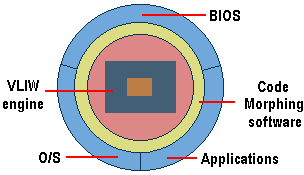
Transmeta’s software translates blocks of x86 instructions once, saving the resulting translation in a translation cache. The next time the (now translated) code is executed, the system skips the translation step and directly executes the existing optimized translation at full speed. This unique approach to executing x86 code eliminates millions of transistors, replacing them with software. The initial implementation of the Crusoe processor uses roughly one-quarter of the logic transistors required for an all-hardware design of similar performance, and offers the following benefits:
- the hardware component is considerably smaller, faster, and more power efficient than conventional chips
- the hardware is fully decoupled from the x86 instruction set architecture, enabling Transmeta’s engineers to take advantage of the latest and best in hardware design trends without affecting legacy software
- the Code Morphing software can evolve separately from hardware, enabling upgrades to the software portion of the microprocessor can be rolled out independently of hardware chip revisions.
This approach makes for great versatility – different goals and constraints in future products may result in different hardware/software partitioning, and the Code Morphing technology is obviously not limited to x86 implementations – and as such has the potential to revolutionize the way microprocessors are designed in the future.
The Crusoe processor family initially consisted of two solutions, the TM5400 and the TM3120. The design objective for both these chips was to minimize die size and power requirements, and this has been achieved by eliminating roughly three quarters of the logic transistors that would be required for an all-hardware design of similar performance. The IBM-produced chips don’t require an on- die cooling mechanism, further reducing the size of the CPU unit. The TM5400 required around 4 watts and the low-end TM3120 as little as 1 watt in some applications.
The model TM5400 was targeted at ultra-light mobile PCs running Microsoft Windows and NT operating systems. These PCs took advantage of the TM5400’s high performance (up to 700MHz), very large cache and advanced power management features to create the longest running mobile PCs for office applications, multimedia games and DVD movies. The TM3120, operating at up to 450MHz, was designed for the Mobile Internet Computing market. This is seen as an important market segment for Crusoe CPUs, and Transmeta collaborated with OEM partner S3 to design and produce a Linux-based Internet appliance that came in a 2-pound package that includes a 10.4-inch screen, hard drive and PC Card slots for additional devices, such as wireless modem cards.
The first system available with the Transmeta Crusoe processor reached the market in the autumn of 2000 – in the shape of a Sony ultraportable laptop – and was immediately embroiled in controversy over the applicability of the traditional one-pass benchmarks used by IT publications to assess the relative performance of different manufacturers offerings. The problem is that since the Transmeta architecture allows for dynamic and smart execution of code in software, the first pass of any test sample is guaranteed to be less than optimal. Thus, the poor results achieved by the first Crusoe-based system to reach the market were both unsurprising and fundamentally flawed.
In late 2000, Transmeta reacted to continuing criticism that its initial processors had been underpowered by announcing both updates to its code morphing software (CMS) and its next generation Crusoe 2.0 chip. In combination, the updated software and new hardware are expected to increase Crusoe performance by at least 40%. In mid-2002, the hardware portion of the new chip was increased from 128 bits to 256 bits, enabling it to handle eight instructions per clock – twice the previous number. At introduction, the chip ran at speeds of 1GHz+ with a typical power consumption of half a watt or less.
In January 2005 Transmeta announced that it was suspending production of its Crusoe processors and focusing on licensing its technology going forward. In the end, the company’s legacy is that Intel’s Pentium-M (the company’s first chip designed from the ground up to power notebooks) and its subsequent hugely successful marketing of the Centrino brand, may both have been a little slower coming than they were without the competitive pressure Crusoe was able to exert in the early 2000s.