pctechguide.com

  • Home
  • Guides
  • Tutorials
  • Articles
  • Reviews
  • Glossary
  • Contact

Graphic Card Display Port – History

Announced in May 2006, the new DisplayPort standard was developed by a VESA Task Group comprised of leading companies in the display silicon, connector, computer monitor, TV display, projector, and PC industry segments. Key objectives were to specify an open, licence-free digital display interconnect standard, agnostic to application/topology/data-type, and with a low power, low pin count, low profile video interconnect connector suitable for use on notebook PCs and other portable devices.

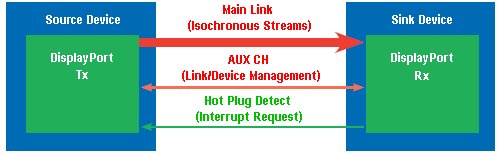
The DisplayPort 1.0 specification supports a single, unidirectional four-lane link for transporting isochronous A/V streams, capable of a maximum transfer rate of 10.8Gbit/s. This is sufficient for one uncompressed video stream and associated audio. Two link rates are supported: 2.7Gbit/s and 1.62Gbit/s per lane. The capabilities of the DisplayPort transmitter and receiver, and the quality of the channel will determine what link rate is used. The video signal supports 8 or 10 bit pixel format per colour channel and is not compatible with either DVI or HDMI. A bi-directional auxiliary channel running at constant 1 Mbit/s is used for command and control functions. The HPD signal also serves as an interrupt request by sink device.
DisplayPort

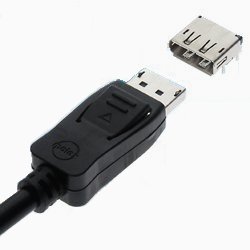
DisplayPort’s electrical interface is similar to the PCI Express physical layer and its ultra slimline connector been designed to support both internal and external display connections. Up to 4 connectors can be accommodated on a PCI card and cable lengths of up to 15 metres are supported. With Dell, HP and Lenovo amongst its proponents, VESA is hoping notebook vendors will use it for connecting the LCD to the motherboard – facilitating easier upgrades – as well as for supporting standalone monitors. The connector has an optional latching feature, which will prevent the undesirable cable fall-off which can be especially problematic with a heavy, long-hop cable-connector assembly.
DisplayPort

DisplayPort includes an optional copy-protection technology that is different from from the Intel HDCP scheme used in both HDMI and DVI. The DisplayPort Copy Protection (DPCP) system developed by Philips uses an 128-bit Advanced Encryption Standard (AES) encryption, with secure modern ciphers, rather than the 40-bit key used in HDCP. It also features full authentication and session key establishment (each encryption session is independent) as well as support for checking the proximity of the transmitter and receiver to ensure users aren’t sending content over the Internet.

Not long after VESA revealed it was working on DisplayPort, a separate consortium proposed the Unified Display Interface (UDI) which, unlike DisplayPort, is designed to be compatible with both HDMI and DVI.

  • How Do Computers Make Pictures?
  • Graphic Card Resolution
  • Graphic Card Colour Depth
  • Graphic Card Components
  • Graphic Card Memory
  • Graphic Card Driver Software
  • 3d Accelerated Graphic Cards
  • Graphic Card Geometry
  • 3D Rendering
  • FSAA Graphic Card Technology
  • Digital Graphic Cards
  • DVI Graphic Cards
  • HDCP Technology
  • Graphic Card HDMI Ports
  • Graphic Card Display Port
  • Unified Display Special Interest Group
  • DirectX
  • OpenGL technology
  • Direct3D
  • Talisman
  • Fahrenheit Graphic Cards
  • SLI Technology
  • CrossFire Graphic Cards

Filed Under: Graphics Cards

Latest Articles

Five Tips to Convert Servers to Virtualization

Virtualization has become a popular topic in the business world. It makes sense on so many levels, and, therefore, it has been on the mind of many people in the IT industry. Servers are perhaps the most popular piece of the IT puzzle to virtualize. Furthermore, they usually make the most sense to … [Read More...]

Revolutionize Your Internet Experience with Orbi 960 – The Ultimate WiFi System

In a world where seamless connectivity is essential, slow and unreliable internet connections are a major problem. Whether you are running a business, working from home, streaming content, or gaming online, the need for lightning-fast internet speeds and uninterrupted connectivity is no longer a … [Read More...]

Biggest Limitations With The Gimp Photo Editing Software

Gimp is a popular photo editing tool that was released in 1998. Although it is very popular, it still is not as reliable or convenient as Photoshop. You need to be aware of the limits as a photo editor. You should either use the premium version of Photoshop or hire a professional developer. … [Read More...]

Importance of Inbound Marketing in the Digital Age

A couple of months ago, Zacks reported that Hubspot was starting to make some major changes to its inbound marketing strategy. They talk a lot about … [Read More...]

Damage Control Strategies for Resolving Online PR Crises

Last July, Astrologer faced a major crisis after its CEO went viral at a ColdPlay concert when having an affair. This was just one of the many times a … [Read More...]

AI is Not Killing Computer Jobs Like Doomers Projected

There is no denying the reality that AI technology has played a massive role in disrupting our lives. A growing number of people claim that AI … [Read More...]

Everything You Need to Know About Sourcing Circuit Boards From U.S. Suppliers

In This Article This article includes: Why Source PCBs From the United States?How to Get a Quote From a U.S.-Based PCB ManufacturerThe Top U.S. … [Read More...]

Top Taplio Alternatives in 2025 : Why MagicPost Leads for LinkedIn Posting ?

LinkedIn has become a strong platform for professionals, creators, and businesses to establish authority, grow networks, and elicit engagement. Simple … [Read More...]

Shocking Cybercrime Statistics for 2025

People all over the world are becoming more concerned about cybercrime than ever. We have recently collected some statistics on this topic and … [Read More...]

Guides

  • Computer Communications
  • Mobile Computing
  • PC Components
  • PC Data Storage
  • PC Input-Output
  • PC Multimedia
  • Processors (CPUs)

Recent Posts

Remove Omiga Plus virus (Removal Guide)

Categorized as a browser hijacker and PUP/Potentially Unwanted Program, is what Omiga Plus is. Once installed, with or without your permission through … [Read More...]

Your Business and the Facebook Dislike Button

The dislike button is finally coming to Facebook. Many people have been asking for this for years. But, businesses are facing the news with some … [Read More...]

What does the data controller have to take into account in order to respond to the exercise of the right to portability under the new GDPR Framework?

It is common to hear about the right to portability in cases such as portability in the telephone industry. We have all tried to change the telephone … [Read More...]

[footer_backtotop]

Copyright © 2026 About | Privacy | Contact Information | Wrtie For Us | Disclaimer | Copyright License | Authors